
Andrei Isichenko successfully defends his PhD
Congratulations, Andrei!
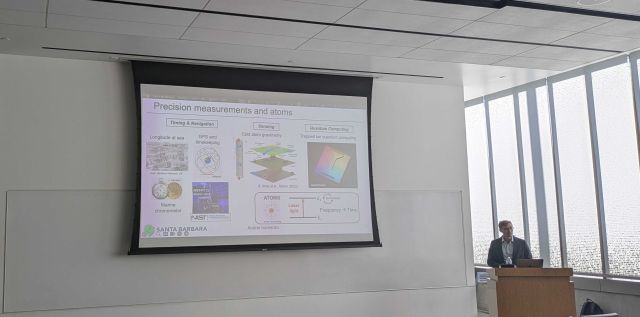
On December 5th 2025, Andrei successfully defended his PhD thesis, "Integrated SiN photonics for rubidium quantum atomic systems."
Abstract:
The miniaturization of atomic and quantum optical systems onto chip-scale platforms promises to transform precision measurement, sensing, and navigation technologies. Rubidium atomic systems are central to precision science, enabling atomic clocks, quantum computers, and cold-atom inertial sensors. While laboratory-based systems have been commercialized, translating their performance outside the lab remains limited by reliance on bulky free-space lasers and optics. Silicon nitride photonic integrated circuits (PICs) provide a path to overcome these limitations through ultra-low optical loss, visible-wavelength transparency, and compatibility with CMOS fabrication. These characteristics enable compact, reliable, and manufacturable systems for applications such as mobile gravity mapping, neutral-atom quantum processors, and atomic clocks.
This work demonstrates and new methodology and operation of integrated silicon nitride based lasers and photonic integrated circuits for 780 nm rubidium atomic quantum systems. The components that will be described include ultra-narrow-linewidth and resonator stabilized lasers, agile tunable resonator and waveguide reference cavities, and photonic circuits and beam delivery for creating cold atoms. Multiple approaches to linewidth narrowing are investigated, including self-injection locking and stimulated Brillouin scattering, capable of achieving sub-hertz fundamental and sub-kHz integral linewidths. Tunable resonator cavities and Brillouin lasers are applied in multi-stage laser stabilization for Rydberg RF quantum sensing and two-photon optical atomic clock demonstrations. Low-power piezoelectric tuning of resonators provides agile frequency control used in sub-Doppler atom cooling. Finally, a photonic-integrated magneto-optical trap (PICMOT) employing large-area grating emitters achieves over one million trapped rubidium atoms at 200 µK, demonstrating a unified, foundry-compatible platform for scalable, low-power, and portable quantum systems.
